FOR SUGAR REFINERS AND BAKING INGREDIENT SUPPLIERS
Distinct packing routes for granulated and icing sugar
A line for granulated sugar should not be specified in the same way as a line for icing sugar. Start with crystal or powder behaviour, then connect dosing to your retail bag and distribution format.

Crystals and icing sugar: compare the whole route
Granulated sugar
For suitable free-flowing crystals, assess cup dosing, linear weighing or combination weighing. Check density variation if using cups and review transfer heights when the condition of the crystals matters.

Controlled feed → cup or weight dose → film bag or premade paper bag → close
Specify particle size, crystal handling and the permitted weight variation.
Explore this equipment Discuss this configurationIcing / powdered sugar
Assess auger dosing and a steady powder supply. The filling nozzle, dust collection and bag-mouth preparation become central to the design. Powder sitting in the seal or fold area needs to be addressed before closing.

Powder feed → auger dose → supported fill → prepare bag mouth → close
Specify powder flow, loose fill volume and the cleaning method between grades.
Explore this equipment Discuss this configurationKeep crystal handling separate from powder control
For granulated sugar: control the transfer
Review unnecessary drop heights, feeder geometry and product impact with the required finished crystal condition. The weigh unit and the bagger should be connected as one handling route.
For icing sugar: manage powder at the mouth
Match the feed rate and auger arrangement to the powder, then allow for dust extraction and preparation of the sealing or folding area. A faster bagger does not remove these filling constraints.
For moist or brown grades: start a new review
Do not extend a free-flowing white-sugar configuration to a moist or sticky grade without assessment. Tell us moisture, lumping and storage conditions before the feeder is selected.
Define the shelf pack and the transport pack

Square paper packs for retail
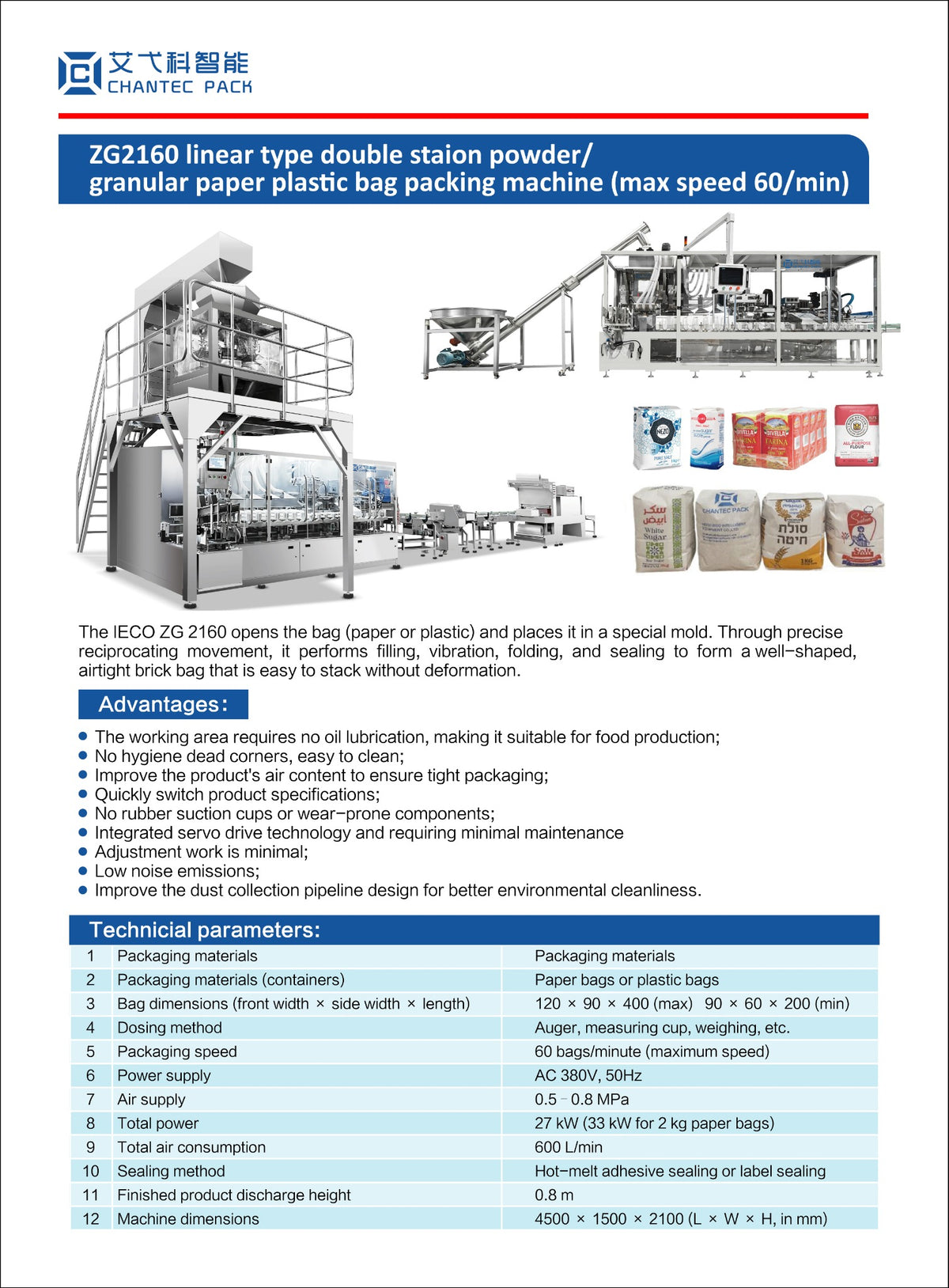
ZG1130 and ZG2160 provide single- and dual-station paper-bag handling for compatible sugar bags. Select the sugar dosing unit together with filling, settling, folding and closure.
Explore this equipment
Group retail bags for distribution
If finished bags must be counted and packed into a larger woven or paper outer bag, define the grouping pattern and outer-bag format with the secondary bagging system. Include its interface in the first layout.
Explore this equipmentAgree the weight result grade by grade
Give the target net weight and allowed variation for each sugar. Where included, the checkweigher provides a separate finished-pack inspection step; its limits and reject method are defined with your quality team.
Changing sugar grade is a production decision
List the grades, batch sizes and changes per shift. We review feeder or auger changes, cleaning access and restart checks so the proposed output reflects your production schedule.
Before we specify the line
Can one dosing unit cover granulated sugar and icing sugar?
It should not be assumed. Free-flowing crystals and a fine powder can require different feeding and dosing principles. We assess both products and the necessary change parts before defining a shared line.
Does a checkweigher replace the filling-system specification?
No. The filler must first be selected for the sugar and dose. A specified checkweigher inspects finished packs against agreed limits; it is a separate station in the quality-control plan.